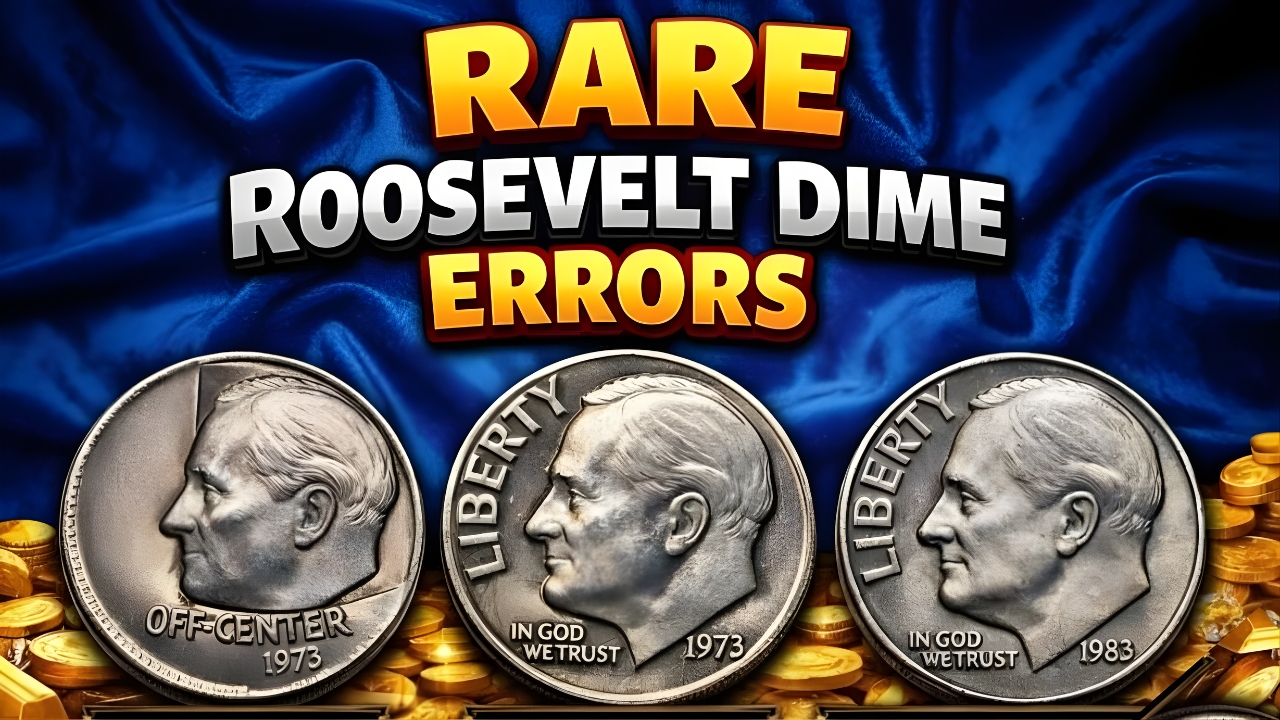
The Roosevelt Dime has been a familiar part of American pocket change for decades, yet hidden among ordinary examples are a handful of rare error coins worth far more than ten cents. While most dimes encountered in circulation hold only face value, certain mistakes made during the minting process have transformed a few pieces into prized collectibles. For collectors who know what to look for, these errors represent an exciting opportunity to discover coins worth thousands of dollars.
First introduced in 1946 to honor President Franklin D. Roosevelt, the Roosevelt Dime replaced the Mercury Dime and has remained in continuous production ever since. Designed by John R. Sinnock, the coin features Roosevelt’s profile on the obverse and a torch flanked by olive and oak branches on the reverse. Over nearly eight decades of production, billions of Roosevelt Dimes have been struck, and with such large numbers, occasional minting errors were inevitable.

Some of these mistakes were caught early and destroyed, but a few slipped into circulation or were released in proof sets. Today, these error coins stand as fascinating reminders of the human and mechanical processes behind coin production. Among them, five particular errors have achieved legendary status in the numismatic community.
1968 No S Proof Roosevelt Dime
One of the most celebrated Roosevelt Dime errors is the 1968 No S proof coin. Proof coins are specially made for collectors using polished dies and planchets, producing sharp details and mirror-like surfaces. These coins are typically struck at the San Francisco Mint and bear an S mintmark.

In 1968, however, a small number of proof dimes were released without the S mintmark. The omission was the result of a die that had not been properly prepared with the mintmark punch. Because proof coins are produced in controlled conditions, such mistakes are extremely rare.
Only a limited number of 1968 No S proof dimes are known to exist, and their scarcity has driven prices into the thousands. High-grade certified examples with pristine surfaces can command significant premiums at auction. Collectors prize them not only for their rarity but also for the clear visual difference compared to standard proof issues.

1975 No S Proof Roosevelt Dime
Even rarer than the 1968 variety is the 1975 No S proof Roosevelt Dime. This coin is widely regarded as one of the rarest modern United States coin errors ever discovered. Like the 1968 version, it was struck without the San Francisco mintmark on a proof coin.
The 1975 No S proof dime is extraordinarily scarce, with only a few confirmed examples. When one appears at auction, it attracts intense attention from advanced collectors. Prices for authenticated specimens have reached remarkable levels, often climbing well into six figures depending on condition and provenance.
The extreme rarity of this coin has made it a centerpiece in many high-end collections. Its existence demonstrates how even in carefully monitored proof production, occasional oversights can result in numismatic treasures.
1982 No P Roosevelt Dime
The 1982 No P Roosevelt Dime is another famous error that has captured collector interest. Beginning in 1980, the Philadelphia Mint started adding a P mintmark to its dimes. However, in 1982, some dimes were struck without the P mintmark due to the use of dies that had not been properly punched.
Unlike the rare proof errors, the 1982 No P dime was released into general circulation. As a result, examples were discovered by ordinary individuals who noticed the missing mintmark in their change. While not as rare as the 1975 No S proof dime, high-grade uncirculated examples of the 1982 No P variety can still bring impressive prices.
Collectors often search rolls of dimes hoping to find one of these elusive pieces. Coins in top condition with minimal wear are especially valuable, as many circulated examples show significant handling.

Off-Center Strike Errors
Off-center strike errors occur when a coin blank is not properly aligned within the striking press. As a result, part of the design is missing, and a blank crescent-shaped area appears on the coin. Roosevelt Dimes with dramatic off-center strikes can be visually striking and highly collectible.
The value of an off-center error depends on several factors, including how much of the design is missing and whether the date is still visible. Coins that retain a clear date while showing a significant off-center strike tend to command the strongest prices. Depending on the severity and condition, these dimes can sell for hundreds or even thousands of dollars.

Collectors appreciate off-center errors for their obvious visual impact. Unlike subtle die varieties, these mistakes are immediately noticeable, making them popular among both seasoned numismatists and newcomers.
Doubled Die Errors
Doubled die errors occur when the die used to strike the coin receives a misaligned impression during its creation. This results in visible doubling of letters, numbers, or design elements. On Roosevelt Dimes, doubling may appear in the date, the word Liberty, or other inscriptions on the obverse.

While many instances of doubling are minor and add only modest value, strong doubled die examples can be highly desirable. The clearer and more dramatic the doubling, the more collectors are willing to pay. As with other errors, condition plays a significant role in determining final market value.
Careful examination with magnification is often required to confirm genuine doubled die characteristics. Collectors must also distinguish between true doubled dies and machine doubling, which is more common and less valuable.

Why Error Coins Command High Prices
Error coins attract strong demand because they combine rarity with an element of intrigue. Each mistake tells a story about the minting process and the occasional imperfections that occur even in highly controlled environments. When an error is both scarce and visually distinctive, it becomes especially appealing.
The Roosevelt Dime series benefits from its long production history and widespread circulation. Billions of coins were struck, but only a tiny fraction contain significant errors. This imbalance between supply and demand supports strong prices for confirmed rare varieties.
In addition, modern collectors often focus on registry sets and certified coins. High-grade error dimes authenticated by professional grading services tend to achieve the highest auction results. Documentation and provenance further enhance desirability.
How to Check Your Dimes
Searching for valuable Roosevelt Dime errors begins with careful observation. Examine the mintmark location near the date on coins produced after 1964. Missing mintmarks on specific years may indicate a rare variety. Inspect the date and lettering closely for signs of doubling.
For off-center errors, look for unusual blank areas where the design is incomplete. Ensure the date is visible, as this significantly affects value. When evaluating proof coins, pay close attention to the presence or absence of the S mintmark.
If a coin appears unusual, avoid cleaning or altering it. Professional evaluation is essential to confirm authenticity and determine grade. Many reputable coin dealers can provide guidance, and third-party grading services offer authentication for significant pieces.
Final Verdict
Rare Roosevelt Dime errors demonstrate how small minting mistakes can transform an everyday coin into a valuable collectible. From the elusive 1975 No S proof dime to the widely sought 1982 No P circulation error, these five coins highlight the excitement of error collecting.
While finding one in pocket change is uncommon, careful inspection and knowledge of key varieties can make all the difference. For collectors willing to look closely, the humble dime may still hold surprising rewards.
Disclaimer
Coin values fluctuate based on rarity, condition, certification, and market demand. The prices referenced in this article are based on historical sales and collector interest and may change over time. Readers should consult qualified numismatic professionals before making buying or selling decisions.