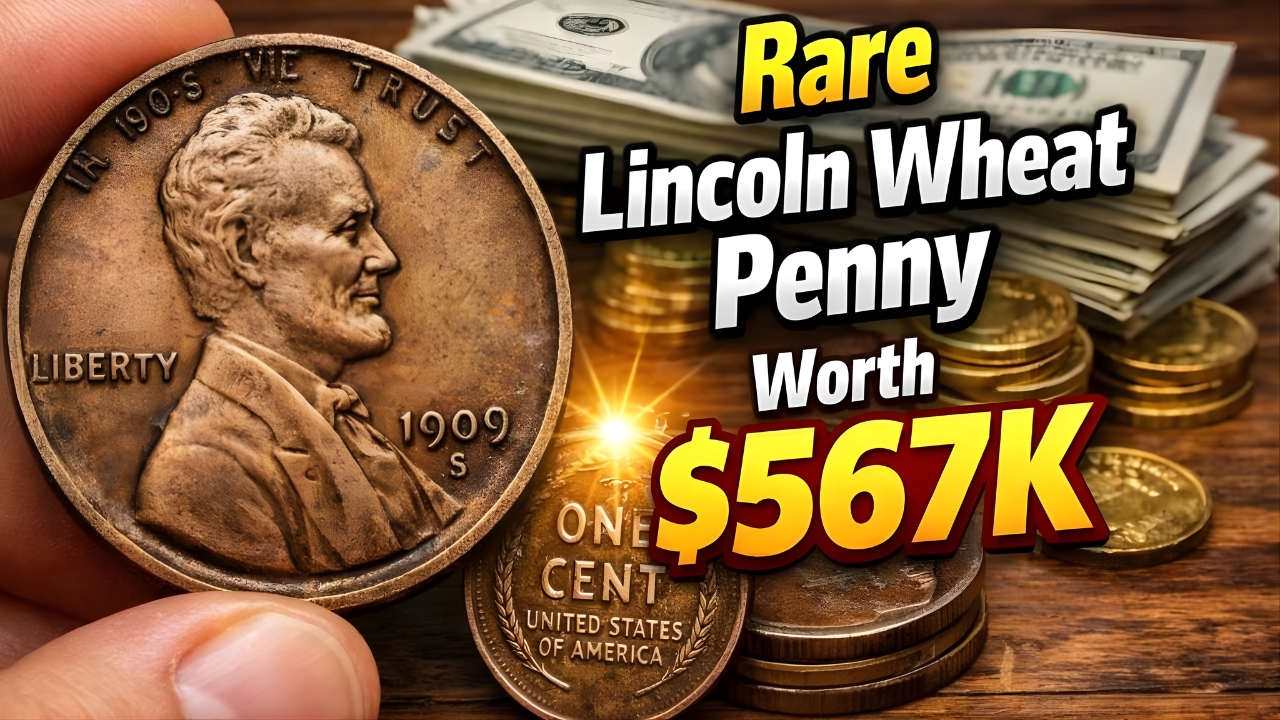
Few American coins capture the imagination of collectors quite like the Lincoln Wheat Penny. First introduced in 1909 to honor the 100th anniversary of Abraham Lincoln’s birth, this small copper coin marked a turning point in U.S. coinage history. It was the first regularly circulating American coin to feature a real historical figure rather than a symbolic representation of liberty. Produced by the United States Mint, the Lincoln cent quickly became a staple of everyday commerce and an enduring symbol of American heritage.
The Wheat Penny, officially known as the Lincoln Wheat Cent, was minted from 1909 through 1958. Its reverse design displays two wheat stalks framing the words One Cent and United States of America. While billions were produced over five decades, certain rare dates, minting errors, and exceptional condition examples have achieved extraordinary auction prices. Among them, one specimen has reportedly reached an astonishing value of $567,000, transforming a humble one-cent coin into a six-figure treasure.

Why Some Lincoln Wheat Pennies Are Worth a Fortune
At first glance, it may seem impossible that a penny could be worth more than half a million dollars. However, coin value is determined by a combination of rarity, condition, historical significance, and collector demand. In the case of the Lincoln Wheat Penny, a few specific factors can dramatically increase its worth.
One of the most important elements is mintage. Some years saw limited production numbers, making surviving examples scarce. Additionally, mint marks from certain facilities are more desirable. Coins struck in San Francisco or Denver during particular years often carry premiums over those minted in Philadelphia.

Another critical factor is error striking. During the minting process, mechanical or human mistakes occasionally occur. When these errors escape into circulation, they can create highly collectible variations. Double dies, off-metal strikes, and transitional errors are especially sought after by serious collectors.
Finally, condition plays a decisive role. A coin that has never circulated and retains full original luster can be exponentially more valuable than a worn example of the same date and mint mark. The difference between average condition and near-perfect condition can mean hundreds of thousands of dollars.
The $567,000 Lincoln Wheat Penny
The Lincoln Wheat Penny that achieved a value of $567,000 stands as a testament to how powerful these factors can be when combined. Although individual sales vary depending on market timing and buyer competition, coins reaching this level typically possess extreme rarity and exceptional preservation.
In most cases, a Lincoln cent commanding such a price will be either a rare transitional error or a remarkably preserved key-date coin. Transitional errors occur when the Mint switches metal compositions or designs and a small number of coins are accidentally struck using outdated materials. These anomalies are historically significant because they represent a moment of change in U.S. coinage.

The legendary 1943 bronze cent is one example of how a rare metal error can skyrocket value. During World War II, pennies were primarily struck in steel to conserve copper for military use. However, a tiny number were mistakenly minted in bronze, creating one of the most famous error coins in American history. Specimens of this nature in top condition have reached extraordinary price levels.
While not every six-figure Wheat Penny is a 1943 bronze example, the principle remains the same. Extreme rarity combined with excellent condition can elevate a simple cent into a headline-making collectible.

Key Dates to Watch
Collectors searching for valuable Lincoln Wheat Pennies often focus on certain key dates. The 1909-S VDB is widely recognized as one of the most important coins in the series due to its low mintage and distinctive initials of designer Victor David Brenner on the reverse. High-grade examples of this coin can command significant premiums.
Other notable dates include the 1914-D and 1922 No D varieties. The 1922 No D coin is particularly intriguing because it resulted from a worn die that failed to properly imprint the Denver mint mark. Genuine examples of this variety are scarce and highly collectible.
Coins from the 1930s and 1940s can also be valuable when preserved in pristine condition. Even more common dates may achieve surprising prices if graded at the very top of the condition scale.
Understanding Mint Marks and Composition
To determine whether your Lincoln Wheat Penny could be valuable, begin by checking the date and mint mark. The mint mark is located below the date on the obverse side of the coin. A D indicates Denver, an S indicates San Francisco, and the absence of a mark generally means Philadelphia.

Next, consider the coin’s metal composition. Most Wheat Pennies were struck in 95 percent copper. However, as previously mentioned, 1943 steel cents and rare bronze transitional errors can significantly impact value.
Examining the edge and color can provide clues about composition. Steel cents often appear silver or gray and may be magnetic. Bronze cents display a rich reddish or brown tone depending on their level of oxidation and wear.
The Importance of Professional Grading
Condition is assessed through a standardized grading scale that evaluates wear, surface preservation, and eye appeal. Coins graded at the highest levels are scarce because even minimal contact marks can lower the grade.
Professional third-party grading services authenticate and encapsulate coins, providing buyers and sellers with confidence. A Lincoln Wheat Penny graded in near-perfect condition by a respected grading service can command far more than an uncertified coin of uncertain quality.
Collectors pursuing high-value coins often participate in competitive registry sets, which increases demand for the finest known examples. When two determined bidders compete for a rare coin in outstanding condition, prices can rise dramatically.
Could You Have One in Your Change?
Although most Lincoln Wheat Pennies worth hundreds of thousands of dollars have long since been discovered, surprises still occur. Many people inherit coin collections or rediscover old jars of change tucked away in drawers and attics.

When sorting through pennies, pay close attention to the reverse design featuring the wheat stalks, as these coins were minted only until 1958. Inspect each coin under good lighting, looking for unusual characteristics such as doubling in the lettering, off-center strikes, or missing mint marks where one should appear.
Avoid cleaning old coins, as this can reduce value significantly. Even gentle polishing can leave microscopic scratches that diminish desirability among collectors.
Market Trends in 2026
The coin market in 2026 continues to show strong interest in historically significant American coins. Economic uncertainty often drives collectors toward tangible assets, and rare coins provide both historical appeal and investment potential.
Lincoln Wheat Pennies remain among the most accessible entry points into numismatics. While six-figure examples are exceptionally rare, strong demand persists for key dates and top-condition coins. Auction records continue to attract media attention, reinforcing public interest.
As awareness grows through online platforms and collector communities, more individuals are taking a closer look at their old coins. The dream of discovering a valuable penny in everyday change keeps enthusiasm alive.
Protecting and Preserving Your Coins
If you believe you may possess a valuable Lincoln Wheat Penny, proper storage is essential. Keep coins in protective holders designed specifically for numismatic preservation. Avoid exposure to moisture, extreme temperatures, and direct handling.
When in doubt, consult a reputable coin professional for evaluation. Authentication not only confirms legitimacy but also provides peace of mind before making any decisions about selling or insuring a potentially valuable coin.
Final Verdict
The Lincoln Wheat Penny worth $567,000 serves as a powerful reminder that extraordinary value can hide in the most ordinary places. While the vast majority of Wheat Pennies remain worth only a small premium over face value, rare dates, mint errors, and exceptional condition examples can command life-changing sums.
Careful inspection, informed research, and professional authentication are essential steps in determining whether your coin is truly special. Even if the odds are slim, the possibility that a forgotten penny could hold remarkable value continues to captivate collectors in 2026.
Disclaimer
Coin values fluctuate based on market demand, rarity, condition, and broader economic factors. The figures discussed in this article reflect reported market trends and notable sales but do not guarantee similar results for any individual coin. Always seek professional appraisal and authentication before making financial decisions related to collectible coins.