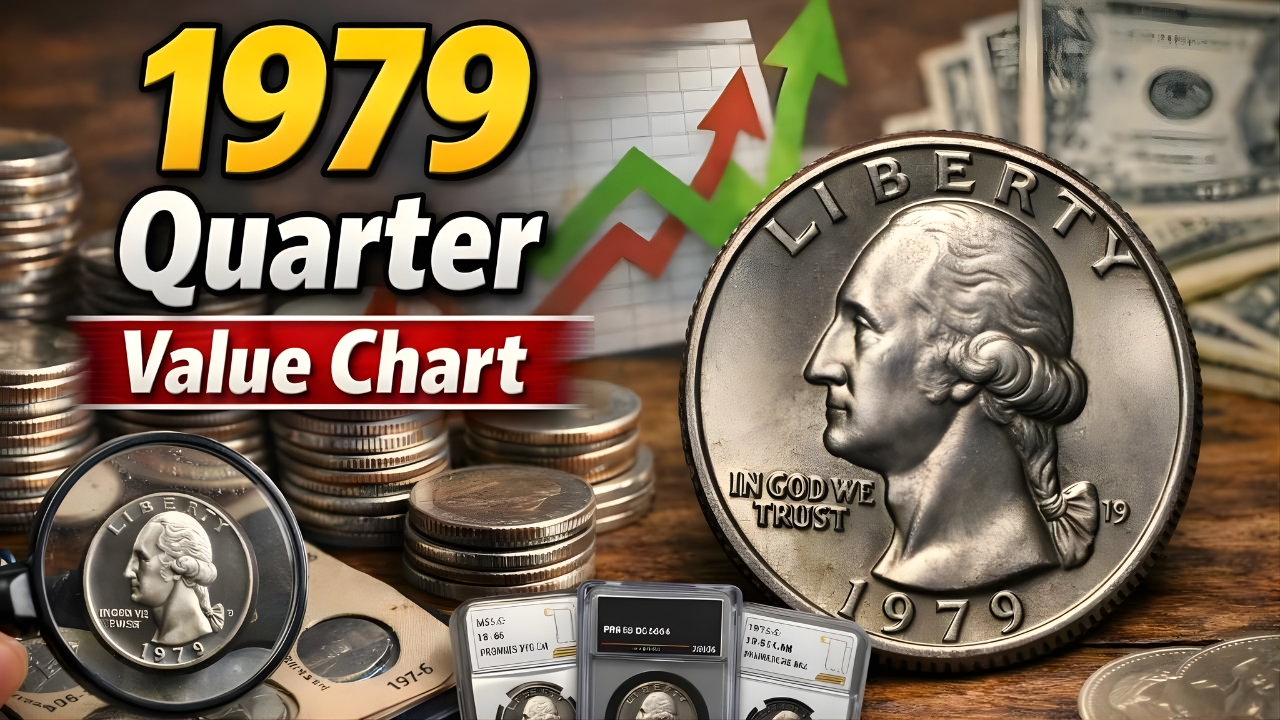
The 1979 quarter may appear ordinary at first glance, but for collectors and treasure hunters, it represents a fascinating chapter in modern American coinage. Produced during a time of economic adjustment and high inflation, the quarter from this year carries more than just face value. While millions were struck for circulation, certain examples featuring rare mint marks, high grades, or unusual production errors have steadily gained attention in the numismatic world.
Most 1979 quarters feature the familiar portrait of George Washington on the obverse and the classic eagle reverse design used prior to the State Quarters era. Because these coins are relatively modern, many people assume they hold little value beyond twenty-five cents. However, hidden within circulation and private collections are pieces that can command hundreds or even thousands of dollars depending on condition and rarity.

Historical Context of the 1979 Washington Quarter
The 1979 quarter belongs to the long-running Washington Quarter series, first introduced in 1932 to commemorate George Washington’s 200th birthday. By 1979, the design had become a standard part of American currency. The obverse portrait by John Flanagan remained unchanged, and the reverse continued to display the heraldic eagle that had defined the series for decades.
The late 1970s were a period of heavy coin production. The United States Mint facilities in Philadelphia and Denver struck large numbers of quarters to meet demand. San Francisco primarily focused on proof coinage intended for collectors. Because mintages were high, the majority of 1979 quarters remain common in circulated grades. Yet, the true story lies in the subtle variations and errors that slipped through quality control.

Mint Marks and Production Numbers
Understanding mint marks is essential when evaluating a 1979 quarter. Coins from Philadelphia typically bear no mint mark for that year. Denver issues carry a small D mint mark, while San Francisco proofs display an S. Although production totals were substantial, not all mints produced equal quality.
Philadelphia struck hundreds of millions of quarters, many of which entered heavy circulation. Denver also produced a large quantity, though some examples show stronger strikes. San Francisco proof coins were manufactured using polished dies and planchets, resulting in mirror-like finishes and sharper detail.

While mint mark alone does not guarantee high value, certain mint-related anomalies and proof varieties can dramatically increase desirability.
The Importance of Condition and Grading
Condition plays a decisive role in determining value. A 1979 quarter that has spent decades in circulation will typically show wear on Washington’s hair, cheek, and the eagle’s wings. Such coins usually remain worth face value unless they display a significant error.

On the other hand, uncirculated examples graded in Mint State can be considerably more valuable. Coins graded MS65 or higher often appeal to registry set collectors who seek the finest available examples. In rare cases, superbly preserved coins graded MS67 or above can reach impressive auction results.
Professional grading services evaluate luster, strike quality, surface preservation, and overall eye appeal. Even minor imperfections can affect price dramatically at higher grade levels.

Hidden Errors That Could Be Worth Thousands
The real excitement surrounding the 1979 quarter lies in error coins. These mistakes occur during the minting process and are typically unintended. Because they are unusual and scarce, collectors actively seek them.
One of the most valuable types of errors involves doubled dies. A doubled die occurs when the coin’s design is impressed more than once in slightly different positions, creating visible doubling on letters or numbers. If clearly defined and confirmed, a doubled die 1979 quarter can attract strong demand.
Off-center strikes also draw attention. These occur when the coin blank is not properly aligned during striking, resulting in part of the design missing. The more dramatic the misalignment, the more valuable the coin may become, especially if the date remains visible.
Clipped planchet errors are another variety worth watching. These coins have a portion missing from the edge due to a mistake during blank production. Genuine clipped planchets show distinctive curved shapes and specific metal flow patterns near the missing area.

Broadstrikes, where coins are struck without the retaining collar, can appear slightly larger in diameter with flattened rims. Though not as rare as some other errors, well-preserved examples still bring premiums.
Perhaps the most intriguing are wrong planchet errors, where a quarter design is struck on a blank intended for a different denomination. Such dramatic mistakes are extremely scarce and can sell for thousands depending on authentication and condition.

The Role of Proof Coins in Value
San Francisco proof quarters from 1979 were not intended for circulation, yet some have entered the market individually after being removed from proof sets. These coins display sharp details and mirror finishes. Most remain affordable, but cameo and deep cameo examples with strong contrast between frosted devices and reflective fields are especially popular.
Proof errors, though rare, can be highly valuable. Because proofs undergo careful inspection, mistakes are less common. When a proof coin displays doubling, striking irregularities, or planchet flaws, collectors often compete aggressively to acquire them.
Market Trends in 2026
As of 2026, interest in modern error coins continues to grow. Collectors appreciate the accessibility of searching through pocket change while still having the possibility of discovering something extraordinary. Online auctions and coin shows have made it easier to identify and trade rare examples.
High-grade certified 1979 quarters have shown steady price appreciation in recent years. Error coins, particularly dramatic and visually obvious ones, have experienced even stronger growth. While not every error commands a fortune, authenticated pieces with clear documentation can exceed four figures.

The market remains selective. Coins with minor machine doubling or damage are often mistaken for valuable varieties but do not command significant premiums. Accurate identification remains crucial.
How to Identify a Valuable 1979 Quarter
Careful inspection is essential. A magnifying glass or coin loupe helps reveal doubling or surface anomalies. Examine the date, lettering, and mint mark closely. Look for unusual alignment, missing design elements, or odd shapes along the edge.
Weight can also provide clues. A standard clad quarter weighs approximately 5.67 grams. Significant deviation may indicate a wrong planchet strike. However, accurate digital scales are required for precise measurement.
Collectors should avoid cleaning coins. Even well-intentioned polishing can reduce value dramatically. Original surfaces are highly prized.
For coins that appear promising, professional evaluation is recommended. Authentication ensures that a perceived error is genuine and not post-mint damage.
Why Some 1979 Quarters Reach High Prices
The combination of rarity, condition, and demand determines price. A common circulated 1979 quarter remains worth face value because supply is abundant. Conversely, a rare doubled die in Mint State condition may be one of only a handful known.
Collectors also value eye appeal. A dramatic off-center strike that retains a clear date may attract more attention than a subtle error. Auction dynamics further influence results. Competitive bidding can drive prices higher when multiple buyers seek the same coin.
Registry set competition also plays a role. Collectors striving for top rankings may pay premiums for the highest graded examples, even if the difference between grades is minimal.
Comparing 1979 Quarters to Other Valuable Years
While 1979 quarters have their share of collectible varieties, they compete with other modern issues for attention. Certain earlier Washington quarters, such as silver compositions from pre-1965 years, possess intrinsic metal value. Others feature well-known doubled dies or rare mint errors.
However, modern clad quarters offer an appealing entry point for new collectors. The possibility of finding a valuable error in everyday change keeps interest alive. In that sense, the 1979 quarter stands as a reminder that rarity is not always tied to age.
Preserving and Storing Your Coins
Proper storage protects potential value. Coins should be kept in holders that prevent scratching and environmental damage. Humidity and exposure to chemicals can cause discoloration or corrosion over time.
Handling should be minimal and done by the edges only. Even fingerprints can leave permanent marks on high-grade surfaces.
Collectors who assemble multiple varieties often document their findings carefully. Detailed records help establish provenance and support future resale value.
Final Verdict
The 1979 quarter may seem ordinary, but hidden among millions of common pieces are rare errors and high-grade examples capable of commanding impressive prices. While most remain worth twenty-five cents, a small number featuring doubled dies, off-center strikes, wrong planchets, or exceptional preservation can reach into the thousands.
Careful inspection, proper identification, and professional authentication are essential for uncovering true value. For collectors willing to look closely, the 1979 quarter offers both accessibility and the thrill of discovery.
Disclaimer
This article is intended for informational purposes only. Coin values fluctuate based on market demand, condition, and authentication. Prices mentioned are general estimates and not guarantees of actual sale results. Readers are encouraged to consult professional numismatists or certified grading services before making buying or selling decisions.